

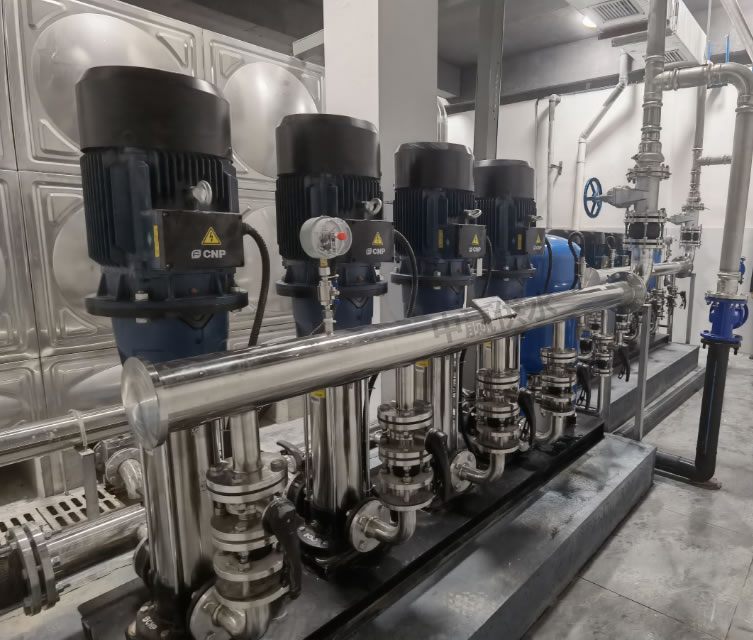
The advancement of smart water management has led to a continuous growth in market demand for fully automatic variable frequency water supply systems
2026/1/14??????view:
With the acceleration of China's urbanization process, there is a robust demand for the renovation of urban water supply facilities. The continuous increase in the domestic urbanization rate has brought vast market potential for fully automatic variable frequency water supply systems. Policies are continuously increasing investment in the renovation and upgrading of water supply systems in old residential areas, promoting the popularization of fully automatic variable frequency water supply systems. The vigorous promotion of smart water management has made fully automatic variable frequency water supply systems, as an important component of smart water management, see a continuous growth in market demand. With the rapid development of technologies such as the Internet of Things (IoT), big data, and artificial intelligence, fully automatic variable frequency water supply systems will achieve more intelligent operation and management. By integrating sensors and intelligent control systems, equipment can monitor water quality, quantity, and pressure in real time, automatically adjusting operational parameters to achieve optimized water supply effects. For example, AI algorithm optimization, IoT integration, and collaboration with new energy systems will become key focuses of future technological development.
1. Save energy and reduce operating costs
Variable frequency and constant pressure technology, precisely matching demand
Principle: The system monitors the pressure of the pipe network in real-time through pressure sensors, and the frequency converter automatically adjusts the pump speed according to pressure changes, ensuring that the water supply pressure remains stable near the set value.
Effect: It avoids the phenomenon of "overkill" caused by pressure fluctuations in traditional water supply systems, achieving an energy-saving rate of 20%-50%. For example, after the renovation of a high-rise residential area, the annual electricity consumption decreased from 480,000 kWh to 320,000 kWh, saving approximately 100,000 yuan in electricity bills.
Applicable scenarios: Places with significant fluctuations in water usage (such as schools, hospitals, and commercial complexes).
Soft start and sleep functions to reduce energy consumption
Soft start: The frequency converter achieves soft start for the motor, reducing the current surge from 5-7 times the rated current in traditional start-up to within 1.5 times, extending the motor's lifespan and reducing start-up energy consumption.
Sleep mode: When water usage is low (such as at night), the system automatically enters a sleep state, maintaining only basic pressure to further reduce energy consumption. For example, when a factory's water usage decreases by 80% at night, the system's power consumption decreases by 90%.
II. Intelligent control, convenient and efficient operation and maintenance
Remote monitoring and fault warning
Internet of Things Integration: Through sensors and cloud platforms, real-time upload of equipment operation data (such as pressure, flow, energy consumption, motor temperature) is supported, enabling remote monitoring via mobile APP or computer.
Fault Early Warning: AI algorithms analyze data to predict equipment failures (such as bearing wear and motor overheating) in advance and send alarm messages to operation and maintenance personnel. For example, a hospital pump station uses AI to predict bearing lifespan and issues maintenance reminders 30 days in advance, thus avoiding unplanned downtime.
Data-driven optimization operation strategy
Water usage pattern analysis: Record historical water usage data, generate reports on peak and off-peak water usage periods, and automatically adjust operational strategies (such as pre-charging pressure and off-peak operation).
Collaborative scheduling: It supports docking with the smart water platform to achieve collaborative scheduling of regional water supply systems and enhance overall energy efficiency. For instance, a certain city has reduced the leakage rate of its pipeline network from 15% to 8% through intelligent scheduling.
III. Stable and reliable, ensuring water supply quality
Multiple protection mechanisms
Electrical protection: Equipped with protection functions such as overvoltage, undervoltage, overload, phase loss, and short circuit, to prevent equipment damage.
Mechanical protection: Explosion-proof pump stations can be applied in hazardous scenarios such as oil and gas, coal mines, etc., ensuring safe operation.
Water quality protection: The fully enclosed pipeline design prevents secondary pollution, and the stainless steel water tank and fittings meet drinking water hygiene standards, supporting regular automatic cleaning and disinfection.
Redundant design enhances reliability
Standby pump switching: Supports "one in use, one standby" or "multiple in use, one standby" modes. When the main pump fails, it automatically switches to the standby pump to ensure uninterrupted water supply. For example, a data center adopts a dual-pump redundancy design and has not experienced a water supply outage for five consecutive years.
Pressure fluctuation suppression: Through the rapid response of the frequency converter to pressure changes, the pressure fluctuation range is controlled within ±0.01 MPa, meeting the water demand of precision industries.
4. Strong environmental adaptability to meet diverse needs
Corrosion resistance and anti-freezing design
Anticorrosion materials: The outer shell of the container is made of anticorrosion coating or stainless steel, and the internal pipelines are made of corrosion-resistant materials such as PPR and 304 stainless steel, suitable for corrosive environments such as seaside areas and chemical industrial parks.
Antifreezing measures: In northern regions, insulation layers and electric heat tracing systems can be installed to prevent freezing and cracking in winter. For example, a pump station in the northeastern region of China can still supply water normally at -30℃ through the use of an electric heat tracing system.
Low noise and elegant design
Noise reduction technology: The enclosed structure and shock absorption design keep noise levels at or below 65dB, meeting the environmental protection requirements of hospitals, schools, and other places.
Appearance customization: The container shell can be sprayed with corporate LOGO or patterns that coordinate with the surrounding environment to enhance visual effects.
Easy to move, fast emergency response
Modular structure: The containerized design facilitates lifting and transportation, enabling rapid deployment to disaster areas, temporary construction sites, and other scenarios. For example, during a flood in a certain city, the containerized drainage pump station was deployed within 2 hours, achieving a daily pumping capacity of 50,000 cubic meters.
Example application scenario of fully automatic variable frequency water supply system
Municipal water supply: Addressing pressure decay in old and outdated pipe networks, and enhancing the water usage experience for end-users.
Industrial field: Provides a stable pressure source for cooling and circulating systems, cleaning equipment, etc., reducing energy consumption.
Commercial buildings: Meet the peak water demand of places such as shopping malls and hotels, avoiding insufficient water pressure.
Residential area: Replace traditional high-level water tanks to avoid secondary pollution and achieve 24-hour constant pressure water supply.
Emergency scenario: Rapid deployment to disaster areas or temporary construction sites to provide temporary water supply or drainage solutions.
Under the guidance of stricter environmental protection policies and the "dual carbon" goals, fully automatic variable frequency water supply systems will continue to optimize their design, adopting more energy-saving materials and processes. For example, new energy-saving motors and high-efficiency water pumps are used to reduce energy consumption during equipment operation. By optimizing the design of water supply networks, leakage is reduced, and water resource utilization efficiency is improved. Some companies have developed equipment with energy consumption reduced by more than 30%, and the energy-saving effect will be further enhanced in the future.
1. Save energy and reduce operating costs
Variable frequency and constant pressure technology, precisely matching demand
Principle: The system monitors the pressure of the pipe network in real-time through pressure sensors, and the frequency converter automatically adjusts the pump speed according to pressure changes, ensuring that the water supply pressure remains stable near the set value.
Effect: It avoids the phenomenon of "overkill" caused by pressure fluctuations in traditional water supply systems, achieving an energy-saving rate of 20%-50%. For example, after the renovation of a high-rise residential area, the annual electricity consumption decreased from 480,000 kWh to 320,000 kWh, saving approximately 100,000 yuan in electricity bills.
Applicable scenarios: Places with significant fluctuations in water usage (such as schools, hospitals, and commercial complexes).
Soft start and sleep functions to reduce energy consumption
Soft start: The frequency converter achieves soft start for the motor, reducing the current surge from 5-7 times the rated current in traditional start-up to within 1.5 times, extending the motor's lifespan and reducing start-up energy consumption.
Sleep mode: When water usage is low (such as at night), the system automatically enters a sleep state, maintaining only basic pressure to further reduce energy consumption. For example, when a factory's water usage decreases by 80% at night, the system's power consumption decreases by 90%.
II. Intelligent control, convenient and efficient operation and maintenance
Remote monitoring and fault warning
Internet of Things Integration: Through sensors and cloud platforms, real-time upload of equipment operation data (such as pressure, flow, energy consumption, motor temperature) is supported, enabling remote monitoring via mobile APP or computer.
Fault Early Warning: AI algorithms analyze data to predict equipment failures (such as bearing wear and motor overheating) in advance and send alarm messages to operation and maintenance personnel. For example, a hospital pump station uses AI to predict bearing lifespan and issues maintenance reminders 30 days in advance, thus avoiding unplanned downtime.
Data-driven optimization operation strategy
Water usage pattern analysis: Record historical water usage data, generate reports on peak and off-peak water usage periods, and automatically adjust operational strategies (such as pre-charging pressure and off-peak operation).
Collaborative scheduling: It supports docking with the smart water platform to achieve collaborative scheduling of regional water supply systems and enhance overall energy efficiency. For instance, a certain city has reduced the leakage rate of its pipeline network from 15% to 8% through intelligent scheduling.
III. Stable and reliable, ensuring water supply quality
Multiple protection mechanisms
Electrical protection: Equipped with protection functions such as overvoltage, undervoltage, overload, phase loss, and short circuit, to prevent equipment damage.
Mechanical protection: Explosion-proof pump stations can be applied in hazardous scenarios such as oil and gas, coal mines, etc., ensuring safe operation.
Water quality protection: The fully enclosed pipeline design prevents secondary pollution, and the stainless steel water tank and fittings meet drinking water hygiene standards, supporting regular automatic cleaning and disinfection.
Redundant design enhances reliability
Standby pump switching: Supports "one in use, one standby" or "multiple in use, one standby" modes. When the main pump fails, it automatically switches to the standby pump to ensure uninterrupted water supply. For example, a data center adopts a dual-pump redundancy design and has not experienced a water supply outage for five consecutive years.
Pressure fluctuation suppression: Through the rapid response of the frequency converter to pressure changes, the pressure fluctuation range is controlled within ±0.01 MPa, meeting the water demand of precision industries.
4. Strong environmental adaptability to meet diverse needs
Corrosion resistance and anti-freezing design
Anticorrosion materials: The outer shell of the container is made of anticorrosion coating or stainless steel, and the internal pipelines are made of corrosion-resistant materials such as PPR and 304 stainless steel, suitable for corrosive environments such as seaside areas and chemical industrial parks.
Antifreezing measures: In northern regions, insulation layers and electric heat tracing systems can be installed to prevent freezing and cracking in winter. For example, a pump station in the northeastern region of China can still supply water normally at -30℃ through the use of an electric heat tracing system.
Low noise and elegant design
Noise reduction technology: The enclosed structure and shock absorption design keep noise levels at or below 65dB, meeting the environmental protection requirements of hospitals, schools, and other places.
Appearance customization: The container shell can be sprayed with corporate LOGO or patterns that coordinate with the surrounding environment to enhance visual effects.
Easy to move, fast emergency response
Modular structure: The containerized design facilitates lifting and transportation, enabling rapid deployment to disaster areas, temporary construction sites, and other scenarios. For example, during a flood in a certain city, the containerized drainage pump station was deployed within 2 hours, achieving a daily pumping capacity of 50,000 cubic meters.
Example application scenario of fully automatic variable frequency water supply system
Municipal water supply: Addressing pressure decay in old and outdated pipe networks, and enhancing the water usage experience for end-users.
Industrial field: Provides a stable pressure source for cooling and circulating systems, cleaning equipment, etc., reducing energy consumption.
Commercial buildings: Meet the peak water demand of places such as shopping malls and hotels, avoiding insufficient water pressure.
Residential area: Replace traditional high-level water tanks to avoid secondary pollution and achieve 24-hour constant pressure water supply.
Emergency scenario: Rapid deployment to disaster areas or temporary construction sites to provide temporary water supply or drainage solutions.
- Pre:Manufacturers of variable freq 2026/1/14
- Next:Manufacturers of complete non- 2026/1/14
